
|
Math Activity Themes: Spiders |
|
Spider Math Activities

Each of these activities capitalize on students' fascination with spiders. They develop mathematical concepts using a spider theme.
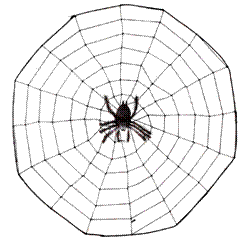
Spider Web Math Mats
|

|
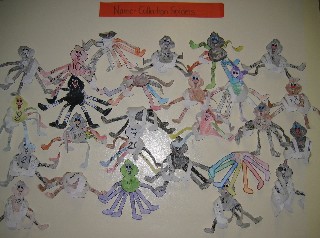
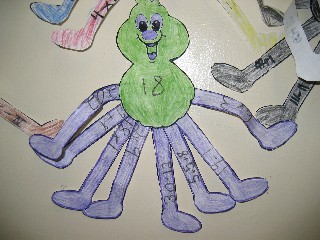
Name-Collection Spiders
Ms. Collier's and Ms. Rachko's classes created Name-Collection spiders for Halloween. These fourth grade students at Joseph C. Caruso School in Keansburg, NJ, extended the Everyday Math name-collection box routine to writing 8 different names for each number, one for each spider leg.
|
|
Spider Glyphs & Graphing Ideas
Spider Glyphs
- Students simply color in this
 Spider Glyph to record data.
Spider Graphing
- See the results of the Spider Poll Mrs. Ritenour's students administered. Third graders created a pictograph, titled, Do You Have Arachnophobia? of the results for all to see. A picture may be worth a thousand words, but each spider is only worth 2 votes.
Math-Literature Connections: Spiders

The Very Busy Spider by Eric Carle |
Math Activities: Patterns
|


Spider Games
|
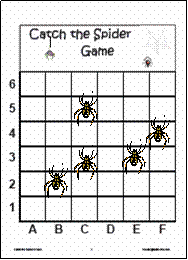
Catch the Spider Game The game file contains the gameboard, spider pieces, directions and a recording sheet. This seasonal version of the classic Battleship game provides practice in forming coordinate pairs, identifying the x-coordinate (A-F), then the y-coordinate (1-6) so that spaces are identified as C3 or E6. Hopefully, lots of practice will help students transition to the algebraic ordered pairs (x,y) where x and y are both numbers. Just be certain to reinforce the notion that the x-coordinate (across) comes before the y-coordinate (up or down). The alphabetical cues (across comes before up or down) help some students remember the order. |
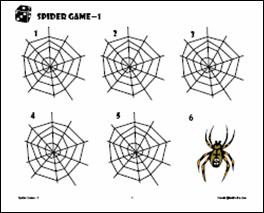
Spider Game - 1
|
|
|
Spider Game - 2
|
|
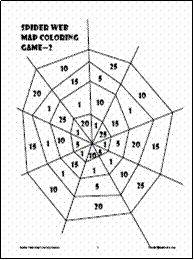
Spider Web Map Coloring Games
|
|
Map Coloring Rules:
|
Spider Problem Solving
Insect and Spider Problems
Solve  Insect and Spider Problems. Given the number of legs and heads, students must figure out how many are insects (6 legs) and how many are spiders (8 legs). The pdf file is formatted to print out individual problem cards that may be placed in a math center for student use. Answer key cards are also included.
- NOTE: A very effective strategy is for students to assume that all heads are insects and determine how many legs were used. Then they distribute the leftover legs, 2 to each insect to create spiders until all of the legs are used.
- Students might also use the
 Insect and Spider Problem Spreadsheet as a strategy that uses technology to help in problem solving. Right click on the link and save the spreadsheet to your computer for easy classroom use. The spreadsheet is already configured for student use. They should only type in the yellow spaces as the spreadsheet will compute the other columns. Use an overhead monitor or projection system to model using the spreadsheet.

Spider Links
- The Spiders Unit from SEDL integrates math, science and language.
- In the Spider Count Game students roll a die, then color in that many spiders in their webs. The first student to color in all of his/her spiders wins the game.
- Spider Glyph is a simple coloring activity that captures data about students' experiences with and attitudes toward spiders.
- Math Cats' Spider Math: students draw half of a spider on a coordinate grid then trade with their partner who must complete the spider so that it is symmetrical. Lastly, students must list the points, which when connected in order, will generate the symmetrical spider.
- Help the fly escape from the Spider Maze or solve a simpler Spider Maze.